Try our all new Farm Sampler Box.

Click here to learn more.

Weaning and Pollinators

posted on

July 5, 2026
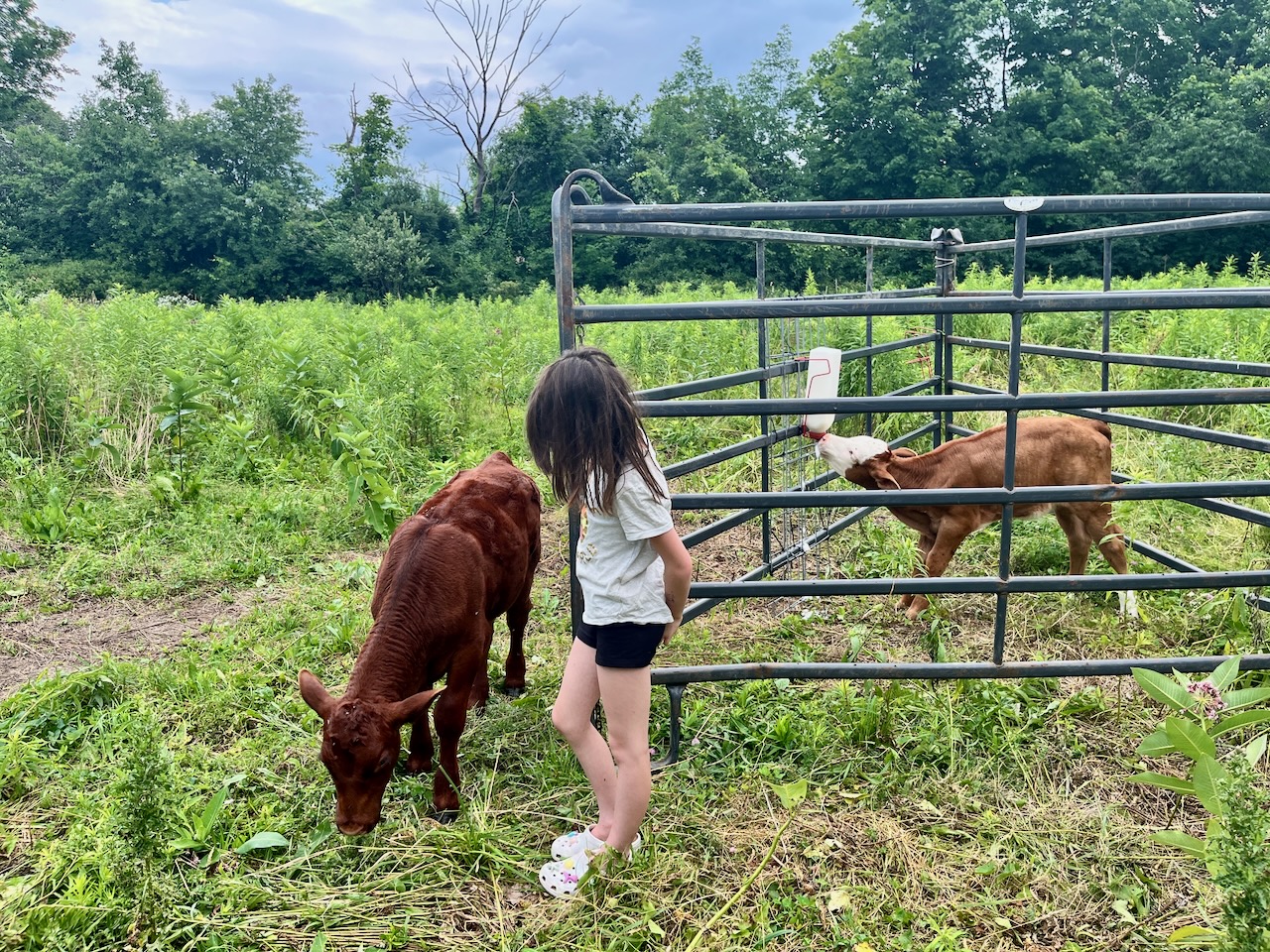
On the farm this week, we all felt the pressure of heat as a heat wave swept across the country, and we saw unusual temperatures in the high 90s during the day. Chickens were hot, pigs needed a bath, and the humans were somewhere in between. Gratefully, nighttime temperatures still dropped back down into the 70s, so it was okay sleeping weather.

Lovett and I have been working on slowly tapering milk consumption for Butter and Vinegar. Vinegar is such a vigorous and rambunctious calf that she quickly steals the bottle from Butter when she has finished her own ration.

So we devised what we call the Butter Room, where Butter is enclosed and can drink her bottle of milk without any interference from Vinegar. Lovett and I have been testing this design, which was not successful at first, since our first exclusion techniques were not tight enough for the persistent Vinegar.

While waiting in their pasture, I have been admiring all the different pollinators coming to the blooming milkweed under the pear tree where I sit and watch them.

Happy summer.

Nathan

Blog

More from the blog

What Is Shaved Pork? A Cut We Came Up With on Our Farm

If you have seen shaved pork in our store and wondered what it is, the short answer is that it's thinly sliced pork from the ham, and it might be the most useful thing in our freezer. The longer answer starts with a question we were trying to solve. The Problem with the Ham A pig gives you a lot of ham. Two of them, in fact, and they are large. The traditional answer is to cure them, and a proper cured ham is one of the great foods of the world. I am not a charcuterie master. And while making a cured ham sounds amazing, it is just not practical for our business right now. If any jamón enthusiasts are reading this, we would love to have you join our team and take our ham game to the next level. So the team and I started asking a different question: how do we create more exciting products from the ham? What We Did The idea we landed on was to break the ham down into its individual muscles and slice them thinly on our bacon slicer. That one change does a few things at once. It turns a large roast that needs hours into something that cooks in about five minutes. It exposes a lot of surface area, so the meat takes a rub or a marinade readily. And because these are whole muscles from the ham rather than a processed product, it is simply pork, sliced thin. How We Cook It What we love about shaved pork is its versatility. We cook with a lot of different flavors in our kitchen, and this one goes wherever we need it to. Mexican. Burritos, tacos, or fajitas. Cumin, smoked paprika, lime, garlic. Asian. Rice and stir fry. Soy, ginger, a little honey or sugar for the sear. Sandwiches. Salt, pepper, and cheese, warmed through and piled on good bread. The basic formula we come back to, whatever direction we are heading, is a little salt, a little sugar, a little acidity, then your spices. Mix it with your hands so it works into each slice. Let it sit while you prep the rest of dinner. Then into a hot pan, marinade and all, for about five minutes with some stirring. That is genuinely the whole technique. It is the kind of cut that rewards improvising with whatever is in the cupboard, which is how most of our weeknight dinners actually happen. Where It Comes From Our pigs are raised on pasture and rotated to fresh ground at least once a week, and they are fed certified organic grain. We do our own butchering here on the farm, which is what makes a product like this possible in the first place. A cut that exists because someone on our team asked a question is not something you can order from a catalog. Shaved pork is available in our store, and if you want a specific place to start, we have a honey lemon pork stir fry recipe that came out of a weeknight dinner with whatever was in the cupboard.

Sliced Ham, Our Answer to the Deli Counter

...If you want to know what's in it, it's simple. We take the whole ham and remove the bone in the middle. The ham is tumbled with a mix of salt and sugar for flavor. Then it is smoked, which in turn cooks the ham. Then we slice it thinly, package it, and it's ready to eat. Nothing more, nothing less.